
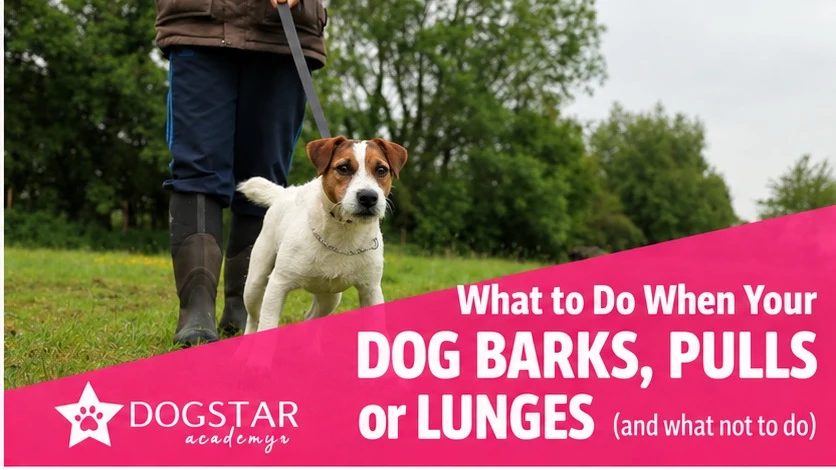
What to Do When Your Dog Barks, Pulls or Lunges (and What Not to Do)
🎉 Download the brochure for the online programme REACTIVITY: Walks Without Drama (coming soon!) →
Guidance, Safety and Self-Regulation
A reactive outburst involving barking or lunging at something or someone happens quickly. One moment your dog seems “OK”; the next, they are barking, pulling, growling or lunging. At that point, we often freeze, get angry or start frantically trying to correct our dog.
But the truth is: during an outburst, your dog is not learning. What we can do in that moment is not training — it is guiding, protecting and calming the situation.
First: What Is Really Happening to Your Dog?
During a reactive outburst, your dog’s body is flooded with stress hormones. Your dog is not consciously choosing their behaviour; they are reacting instinctively. Their nervous system is in “fight or flight” mode.
This means that:
your dog finds it difficult to hear or understand commands,
they are not thinking logically,
and they do not have the same control they have when calm.
That is why the first goal is always to reduce the intensity, not to “correct the behaviour”.
🎉 Download the brochure for the online programme REACTIVITY: Walks Without Drama (coming soon!) →
What to Do During an Outburst
1. Create Distance
Distance is your most powerful tool. More distance means less pressure.
If possible:
move to the side,
turn around,
step behind a car, bush or fence,
or simply move away from the trigger.
It does not matter what this looks like to others. What matters is giving your dog a chance to calm down.
2. Guide Your Dog Calmly and Confidently
During an outburst, your dog needs clear but calm guidance. This means:
a short, firm leash without jerking,
a calm tone of voice,
simple instructions or a familiar cue (if your dog can still respond).
This is not about perfect walking or good manners. It is about helping your dog feel that you have the situation under control.
3. Keep Everyone Safe
During an outburst, it is important:
to prevent your dog from coming into contact with the trigger,
to prevent a bite (including one caused by fear),
and to avoid getting yourself tangled up in the situation.
If your dog is larger or stronger, it may sometimes be safer to focus only on moving away and staying steady rather than communicating with people around you.
🎉 Download the brochure for the online programme REACTIVITY: Walks Without Drama (coming soon!) →
4. Regulate Yourself — Your Dog Can Feel It
Dogs are extremely sensitive to our body language. If you:
hold your breath,
tense your body,
or become anxious,
your dog may also remain stressed for longer.
Try to:
breathe consciously,
relax your shoulders,
slow down your movements whenever possible.
Regulating yourself helps your dog settle more quickly, too.
What Not to Do During an Outburst
1. Do Not Punish Your Dog
Punishment (shouting, leash jerks or corrections) during an outburst:
does not teach,
does not calm,
and often increases fear or frustration.
Your dog may begin to associate the trigger with an additional threat, and their reactivity can increase over time.
2. Do Not Demand Obedience Your Dog Cannot Give
Commands such as “sit”, “look at me” or “be good” often do not work because your dog is physiologically unable to cooperate.
If a command does not work, it is not stubbornness. It is a sign that your dog is already over their threshold.
3. Do Not Keep Explaining That “Everything Is Fine”
Although we may be speaking to ourselves or other people, dogs often pick up tension in our tone of voice. Long explanations and constant talking can stimulate your dog even more.
Sometimes silence is the most calming response.
After the Outburst
Once your dog settles:
do not analyse the situation immediately,
do not punish them afterwards,
do not demand that they “make up for it”.
First, allow your dog to truly calm down. Analysis can come later — at home, in peace.
Questions to ask yourself later:
What was the trigger?
How close were we?
How was my dog feeling beforehand (tired, tense)?
Final Thoughts
A reactive outburst is not a failure. It is information. It tells us that the situation was too difficult for your dog at that moment.
Your job during an outburst is not to train your dog, but to offer guidance, protection and compassion. And that is already a great deal.
🎉 Download the brochure for the online programme REACTIVITY: Walks Without Drama (coming soon!) →