
The Real Reason Some Dogs Are “Badly Behaved”
The behavioural problems I most commonly see in dogs include pulling, growling, barking, lunging, destroying things and mounting. But those are only the things we see on the surface, and we usually want to stop them as quickly as possible. We just want them to end. What we cannot see — and what is actually driving the dog's behaviour — lies beneath the surface, like the rest of an iceberg: fear, frustration, stress, pain, boredom, instincts and more.
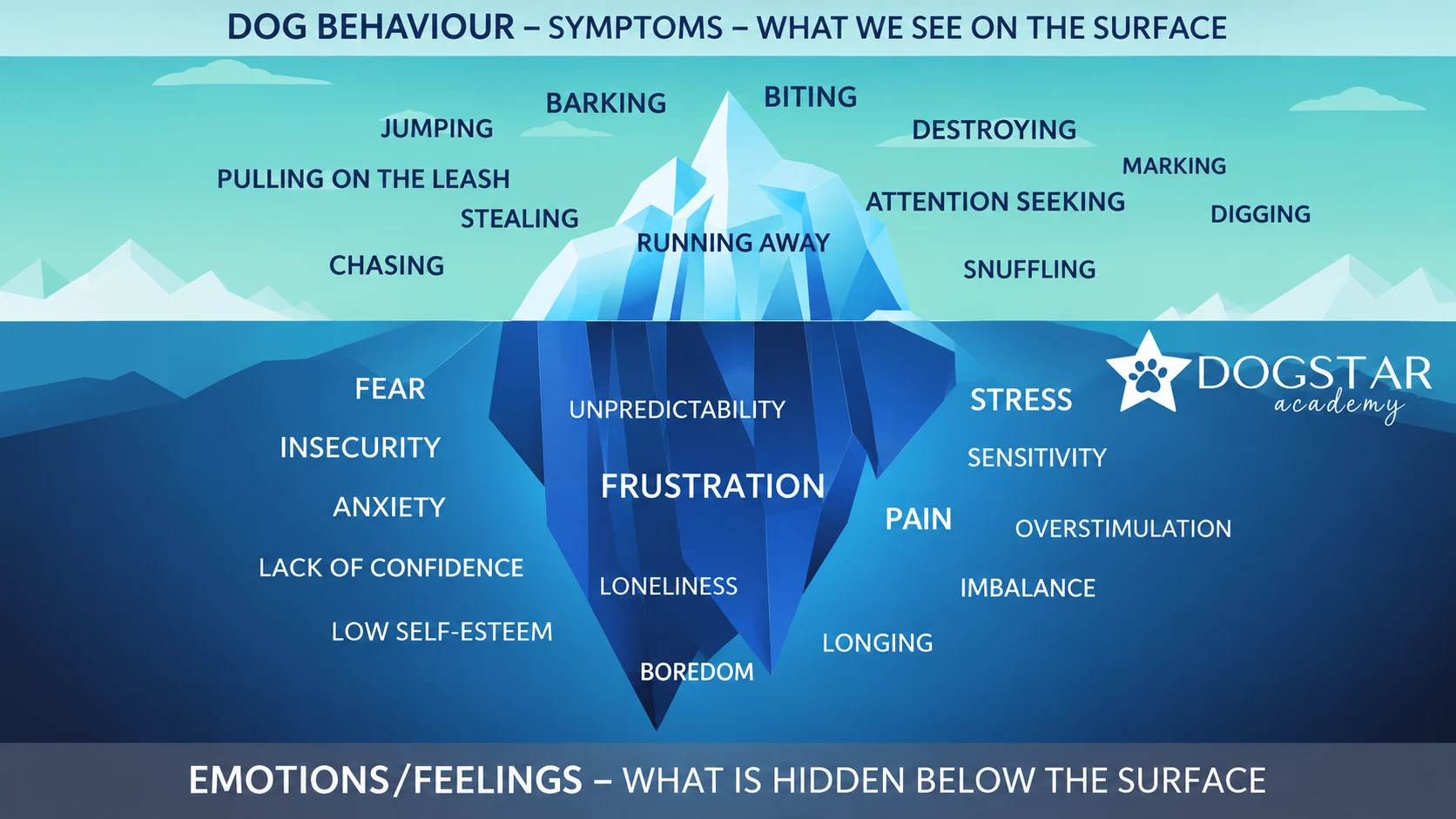
Behaviour is always just the tip of the iceberg!
So, if we want a dog to change its behaviour, we need to find and examine the real CAUSES of that behaviour, rather than focusing only on the symptoms.
When we change how a dog experiences a particular trigger (an object, a sound, a person, another dog and so on), its behaviour changes too. We do this using scientifically supported, reward-based techniques: systematic desensitisation, counterconditioning and reinforcement of alternative behaviours.
Any tool that works by making a dog avoid pain or fear only stops the symptoms. It does not matter how attractively the tool is packaged or presented, or whether someone claims to use it “correctly”. These tools work by making the dog stop showing visible behaviours such as pulling, lunging, growling or chasing. They interrupt or suppress those behaviours. They work on the symptoms, not the cause. They try to break off the tip of the iceberg. But even if they manage to break it off, the enormous part beneath the surface remains.
The risks associated with using tools based on avoiding pain and fear remain as well.
When you see a “calm” dog that has been trained with these methods, this may be a phenomenon called learned helplessness. Learned helplessness is also very common among people. Think of victims of violence who quietly and “calmly” endure abuse and remain in unhealthy relationships.
It is a very similar thing.
Let's learn to do better, even if we have used — or still use — methods designed to suppress behaviour: choke collars, or their more modern versions in various colours, slip leads, prong collars, electric collars, leash jerks and rolling a dog onto its back. I believe these methods work in the sense that they can stop behaviour. I also believe nobody deliberately wants to harm their dog. Everyone wants to solve the problem, make everyday life easier and give their dog a better life.
I believe we can do better because we have the resources available to us. It is 2023, and knowledge is only a few clicks away.
Genuine behavioural treatment addresses the cause, not just the symptoms. That is something we should pay attention to when looking for help with behavioural difficulties.
In cognitive behavioural therapy, we focus on the relationship between behaviour, emotions, thoughts and what happens in the body. We need to pay attention to all these aspects, not only behaviour.